




02 Challenge
Conventional palletizing automation is optimized for stacking identical boxes over and over. In today’s distribution centers and 3PL facilities, however, each order typically combines boxes of many different SKUs (stock-keeping units), each with its own size, shape, and weight, on a single pallet.
When the input changes constantly, pre-teaching every robot motion simply doesn’t scale: the cell would have to be reconfigured every time the order mix changes.
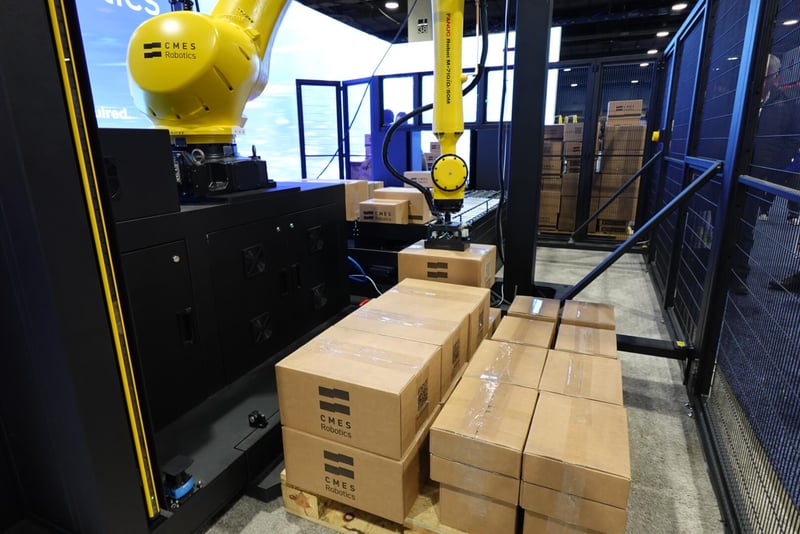
Figure 1. Boxes of different sizes packed closely together on the buffer
The U.S. logistics market in particular demands dense, stable pallets that make the most of available space and don’t shift or collapse in transit. CMES Robotics was already supplying palletizing cells in Korea, but entering the U.S. market called for a solution that could stack a wide variety of boxes tightly and stably without any pre-teaching.
The core of mixed-SKU palletizing is recognizing boxes quickly and accurately as they arrive in no fixed order, then using that information to decide the stacking sequence and placement in real time.
Boxes arriving on the conveyor wait briefly in a buffer zone before the robot picks them. There, the system determines each box’s position, orientation, and dimensions (length, width, and height), and feeds this data into the AI stacking plan. Because this step repeats for every box, any extra time spent on imaging directly slows down overall throughput.
If the 3D measurements deviate from reality, boxes may be placed with unnecessary gaps or collide with one another. As these errors build up layer by layer, pallet stability suffers. Accurately capturing the shape and position of every box was therefore central to the solution.
To work reliably in a real logistics environment, the 3D sensor had to deliver:
- Fast capture: Capture time adds to every cycle, so data must be acquired fast enough not to slow down the line.
- Wide field of view: Multiple boxes on the buffer must be recognized in a single capture.
- High 3D accuracy: The true dimensions and positions of the boxes must be measured precisely.
- Aligned 2D and 3D data: Color images and 3D data must work together to separate boxes that are touching.
- Stability under changing conditions: Measurement performance must stay consistent as lighting and temperature vary.
03 Solution
CMES Robotics built its Mixed-Case Palletizer on a clear division of roles: the Zivid 3 XL250 provides the 3D data needed for box recognition, and CMES Robotics’ proprietary AI uses this data to determine the stacking plan and robot motions. The palletizer handles up to seven different box sizes without requiring a fixed incoming box sequence or WMS integration, so it can adapt to changing box mixes without re-teaching the robot.
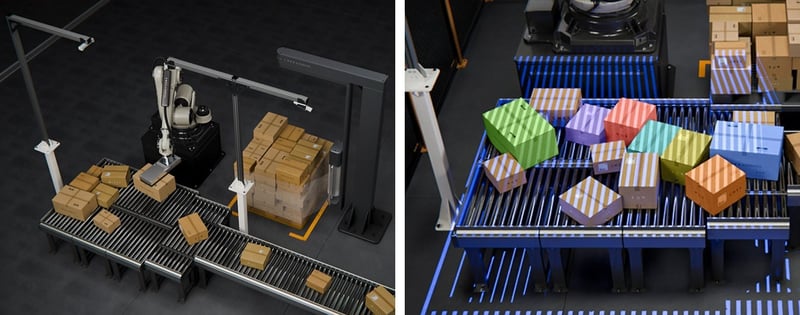
Figure 2. CMES Robotics’ Mixed Case Palletizer (left) and 3D data captured of the boxes on the buffer (right)
How It Works
-
Box recognition on the buffer
Boxes arrive in random order, with no pre-sorting required. Based on 3D data captured by the Zivid 3 XL250, CMES Robotics’ AI recognizes the position and orientation of each box. -
AI-driven pallet optimization
CMES Robotics’ AI generates stable stacking patterns in real time based on the current box mix, maximizing pallet utilization while preventing overhang and unstable stacks. Patterns adapt continuously to help the cell meet its target cycle time and boxes per hour. -
Robotic palletizing
Following the stacking plan, CMES Robotics’ AI calculates the robot path, and the gripper picks each box and places it in its designated position. An integrated lift extends the robot’s reach beyond typical cobot limits, supporting stacking heights of up to 2,000 mm. -
Continuous pallet monitoring
Throughout the process, CMES Robotics’ system uses 3D data to continuously monitor pallet conditions and prevent collisions and overhang before they occur, while operators track KPIs in real time on a unified dashboard.
With this setup, the cell adapts to a different box mix for every order without the robot having to be re-taught.
Built for Fast Deployment and Simple Operation
The Mixed-Case Palletizer is designed to be practical on the warehouse floor. Its foldable, modular architecture enables fast deployment, easy relocation, and simplified maintenance, even in space-constrained facilities, while a 360° LiDAR sensor enhances safety around the cell.
Operators are guided step by step through installation, configuration, and error recovery, and a unified dashboard provides real-time KPIs and actionable operational insights.
Why CMES Robotics Chose the Zivid 3 XL250
The Zivid 3 XL250 combines fast capture, a wide field of view, and high accuracy, meeting all the key requirements of mixed-SKU palletizing.
Fast capture that protects cycle time
In mixed-SKU palletizing, buffer imaging, recognition, stacking planning, and robot motion repeat continuously as boxes are moved. Since imaging time adds to every cycle, faster capture means more boxes handled per hour. The Zivid 3 XL250 captures a wide buffer area in under 500 ms, helping the line keep pace even during peak hours. Just as important, it delivers this speed without compromising accuracy or field of view.
A wide field of view that covers the entire buffer
The Zivid 3 XL250 captures a large area at working distances of up to approximately 4.5 m. This lets it acquire 3D data for multiple boxes on the buffer in a single shot, giving the AI more placement information to work with when selecting the next box.
Millimeter-level measurement accuracy
Zivid 3 delivers 3D measurements with a trueness error below 0.2% of the working distance. Trueness describes how closely a measurement matches the actual value.
Faithfully reproducing the true dimensions and shapes of boxes reduces the gap between the stacking plan and the robot’s actual placement. This is key to minimizing unnecessary gaps between boxes and keeping errors under control as layers build up.
Pixel-aligned 2D and 3D data
Zivid 3 delivers 3D point clouds and 8 MP color images from the same sensor, aligned pixel for pixel. Combining shape and color information makes it easier to find the edges between boxes that are touching or have similar heights, a critical foundation for reliably separating and recognizing boxes in mixed-SKU environments.
Consistent performance in changing conditions
A thermally stable design and fast infield correction help keep measurement performance consistent in logistics environments where operating conditions such as temperature fluctuate.
Faster integration with a familiar SDK
CMES Robotics had already used the Zivid SDK in earlier projects. Being able to use the same SDK and calibration workflow from close-range picking to pallet-scale imaging reduced the development effort required to integrate the new vision system.
The Zivid 3 XL250 provides the accurate 3D data that mixed-SKU palletizing requires, and CMES Robotics’ AI uses it to recognize boxes and determine stacking patterns and robot motions. The result is a system that adapts to changing orders without pre-teaching.
04 Results
CMES Robotics unveiled its Mixed-Case Palletizer, combining 3D vision and AI, at PACK EXPO 2026 in Chicago. The live demonstration showed boxes of different sizes and shapes being stacked densely on a single pallet, with no pre-teaching required.
Figure 3. CMES Robotics’ AI mixed-SKU palletizing solution demonstrated at PACK EXPO 2026
The project shows that flexible logistics automation becomes possible when precise 3D data is combined with AI that interprets it and makes decisions. With Zivid as its vision technology partner, CMES Robotics has extended palletizing automation beyond uniform loads and introduced a solution built for the U.S. logistics market, where mixed boxes are the norm.
By combining Zivid’s precise 3D data with CMES Robotics’ AI-driven stacking plans, CMES Robotics has simplified mixed-SKU palletizing and laid the groundwork for more flexible logistics automation.