.svg "Zivid")




02 Challenges
Most industrial controllers are built to execute, not to perceive. MOTOMAN NEXT is built differently: vision processing, image analysis, embedded AI, and task planning all run inside the controller itself. That architecture is what let YASKAWA get rid of the usual headaches in vision-guided robotics: brittle programming tied to fixed teaching points, unstable motion when conditions shift, dependence on an external PC for perception, and the integration overhead of bolting a third-party sensor onto the cell.
But none of that works without a 3D sensor that can actually hold up its end. And this is where most cameras fall short. The industrial vision market has matured to the point where almost any competent camera can handle a well-lit bin of matte, palm-sized parts. Very few can handle the scenes that actually cause problems on the floor: reflective machined metal, transparent packaging, deep bins, small densely stacked components, weld spatter, swinging ambient light, and temperature drift. These are exactly the conditions that lead to mispicks, collisions, and damaged product, and they're the conditions any "hard automation" project eventually runs into.
MOTOMAN NEXT's use cases also span a wide range of working distances. Assembly, robot guiding, and inspection need extreme accuracy at short range. Depalletizing and deep bin picking need a longer field of view that covers the full scene without giving up image quality or capture speed. And all of it has to hold up under real factory conditions: temperature swings, shock, vibration, and continuous duty cycles, not just clean lab conditions.
03 Solutions
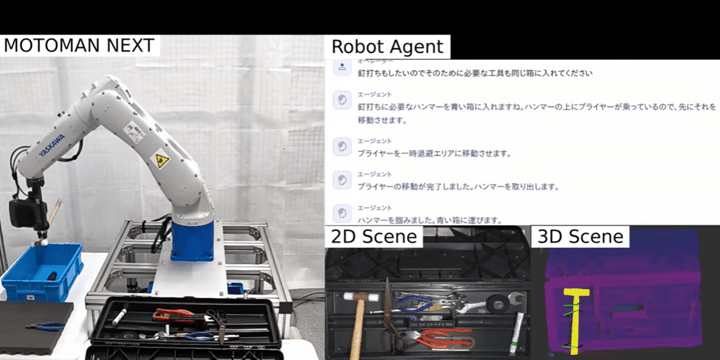
An agentic robotic system approach demo powered by YASKAWA Electric's AI robot, MOTOMAN NEXT, and a Zivid camera. (Watch the demo video)
YASKAWA built its Agentic Robot System on the Zivid 2+ R-series, integrating MOTOMAN NEXT, AI decision-making, and Zivid's 3D vision into one platform. In this system, the robot isn't waiting for a detailed program. It takes a general objective, works out how to achieve it, and adapts autonomously when something goes wrong, whether that's a dropped part or an unexpected obstruction.
Three properties of the Zivid sensor make this possible.
High-quality point clouds even on materials that normally break vision systems. Shiny, transparent, and black parts are where most 3D cameras produce gaps, noise, or false geometry, and where a pick-and-place operation actually fails. Zivid's HDR imaging and reflection handling (the Sage Engine, purpose-built for the vertical reflections common in bins and rack walls) let MOTOMAN NEXT keep picking these difficult items in the SKU mix reliably.
2D and 3D from one device. Because Zivid cameras capture 2D and 3D natively, there's no second camera to mount, no external calibration to maintain, and no drift between the two datasets over time. Both feed the same ground truth into the picking cell, which matters most for AI-based segmentation: it needs a 2D signal that's as stable and consistent as the 3D geometry it's paired with, not two systems that can quietly fall out of sync.
A camera family that covers the whole working envelope. The Zivid 2+ R-series spans short to long working distances within one product line, tuned for logistics, e-commerce, and manufacturing applications. The MR60 is built for close-range assembly, robot guiding, and inspection; the MR130 and LR110 extend that to piece picking, parcel handling, bin picking, and depalletizing. All three models support both stationary and robot-arm mounting, so an integrator can mount the sensor directly on MOTOMAN NEXT's arm to get a closer look from a different angle when the application calls for it. That flexibility maps directly onto the range of serviceable tasks MOTOMAN NEXT is designed to take on.
It in practice
A couple of examples of what this looks like on real production lines:
Unpacking mixed raw materials. Food and chemical plants need to pull raw materials out of cardboard boxes and kraft bags and feed them into machines. The problem: even for the same material, box and bag geometry varies, and packaging gets crushed or deformed in transit or from humidity, which is exactly what breaks fixed-path automation. MOTOMAN NEXT uses the Zivid camera to read the actual condition of each container and sequences the unpacking order accordingly.
Automated packaging with a dual-arm AI robot. Wrapping and boxing products that vary slightly in shape and size demands the kind of judgment that's hard to hard-code. MOTOMAN NEXT uses vision to confirm the position and condition of each object in real time and coordinates both arms to complete the task, without requiring a factory line or workbench redesign to accommodate it.
04 Results
In July 2026, YASKAWA announced it was linking the Agentic Robot System to Google DeepMind's embodied reasoning model, Gemini Robotics ER 1.6. In this configuration, MOTOMAN NEXT's onboard vision, path planning, and force sensing act as the "body" executing what the generative AI decides as the "brain," so an operator can give an instruction like "sort these parts" instead of writing a program for it. The robot still needs to see the scene accurately for any of that decision-making to translate into a successful pick, which is exactly the gap Zivid's sensor is closing.
The applications this opens up extend well past manufacturing industry: logistics, healthcare, construction, food service, and recycling are all sectors currently constrained by labor availability. YASKAWA has said it will continue accelerating toward practical deployment and will share specific application areas and availability once that work is further along.